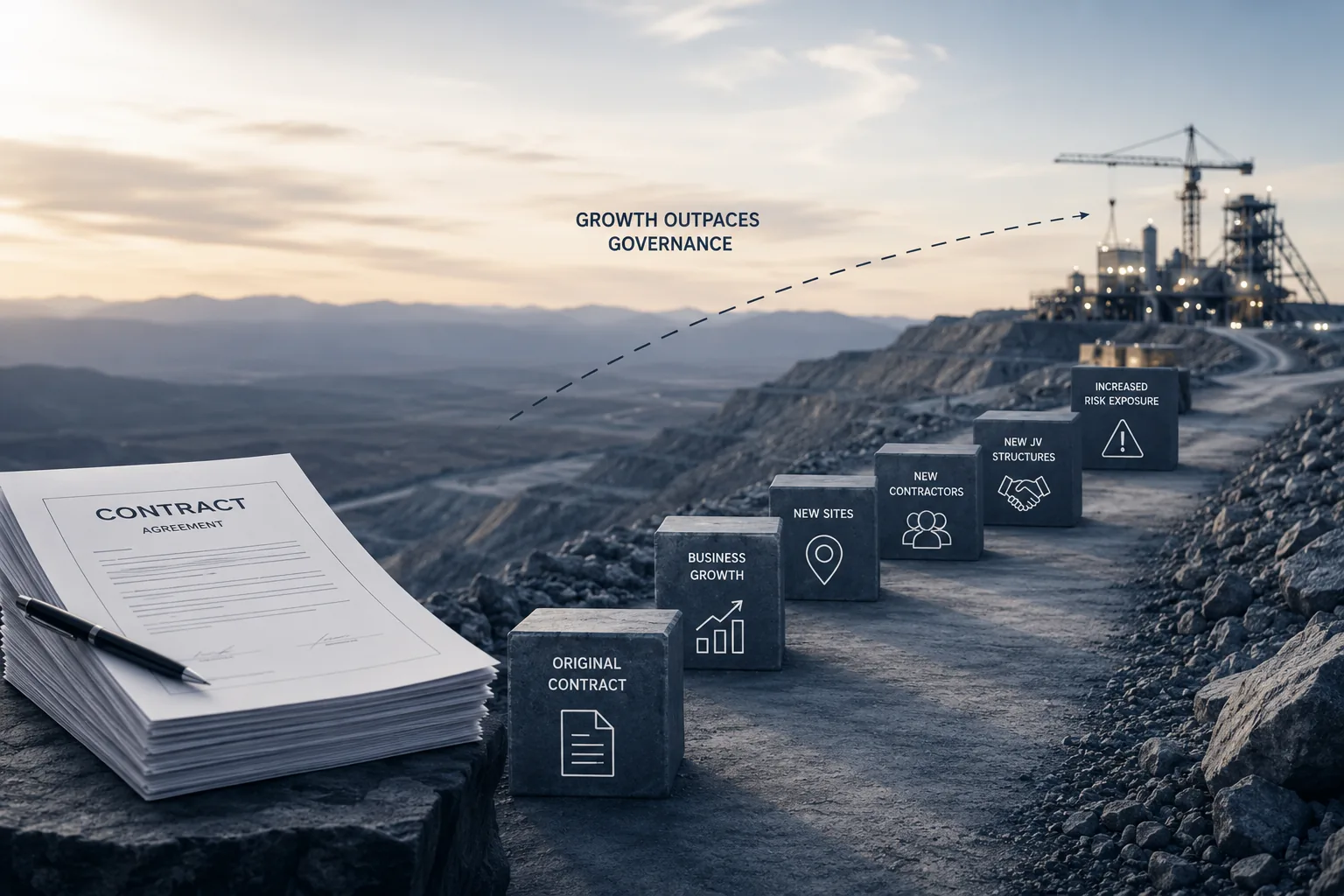
Contracts Don't Scale With You
Why Contract Governance Is Becoming a Strategic Capability
The company had doubled in size within eighteen months.
New projects. New sites. New contractors. New joint ventures.
From a growth perspective, the strategy was working.
Revenue increased. Headcount expanded. Capital projects accelerated.
The organisation was successfully scaling.
Then a dispute emerged.
A contractor submitted a variation claim.
The commercial team pulled the contract from the document management system.
The agreement had been signed two years earlier. At the time, it was entirely fit for purpose.
The problem was that the business no longer resembled the organisation that originally executed the contract.
The operating environment had evolved. The contract had not.
The scope of work had expanded. The contractor relationship had matured. Project complexity had increased. Risk exposure had changed.
Yet the contractual framework remained frozen in time.
The escalation clause referenced a project manager who had long since left the organisation. The variation process assumed a single-site operation. The liability cap reflected a contract value that no longer represented the scale of work being performed.
What initially appeared to be a contractual dispute revealed something much larger.
This was not a legal failure. It was a governance failure.
The Hidden Assumption
Many organisations treat contracts as transactional events.
A contract is negotiated. Signed. Filed.
Then largely forgotten until renewal, termination or dispute.
This approach works reasonably well in stable environments.
Most capital-intensive organisations do not operate in stable environments.
Mining companies expand production. Infrastructure operators acquire new assets. Energy businesses enter new markets. Industrial organisations establish new delivery models.
The business evolves continuously. Contracts often do not.
This creates a dangerous assumption:
That the contract governing today's risks remains suitable for today's business.
Frequently, that assumption is incorrect.
Governance Is Not Documentation
Governance is often associated with policies, procedures and compliance frameworks.
Contract governance is frequently viewed through the same lens.
Do contracts exist? Have they been signed? Are they stored appropriately? Are approval authorities documented?
These are important questions. They are not sufficient questions.
The more important question is:
Do the contracts still reflect operational reality?
A contract may be legally valid while simultaneously creating significant governance risk.
In fact, some of the highest-risk contracts within an organisation are not poorly written contracts.
They are contracts that were once appropriate but have become disconnected from the business they now support.
The Cost of Governance Drift
As organisations grow, governance drift can occur gradually and almost invisibly.
New business units emerge. Projects increase in size. Operational structures evolve. Reporting lines change. Contractor dependencies deepen. Commercial arrangements become more complex.
Yet contract review practices often remain unchanged.
Over time, organisations accumulate a portfolio of agreements that no longer align with:
- Current operating models
- Risk appetite
- Delegations of Authority
- Insurance arrangements
- Project governance structures
- Commercial objectives
This is where governance risk begins to migrate beyond individual projects. It becomes an enterprise issue.
A dispute on one contract may expose weaknesses across dozens of similar agreements. A poorly maintained contractor relationship can create operational disruption across multiple sites. A legacy liability structure can generate exposures far beyond the original commercial intent.
Contract Governance as a Strategic Function
Traditionally, contract management has often been viewed as an administrative or legal responsibility.
Leading organisations are beginning to treat it differently.
Contract governance is increasingly becoming a strategic capability.
Not because contracts are becoming more complex.
But because organisations are becoming more complex.
Effective contract governance requires continuous alignment between:
- Business strategy
- Operational reality
- Risk management
- Commercial structures
- Governance frameworks
This requires more than legal expertise. It requires commercial visibility.
The Role of Data and Systems
One of the most common observations across growing organisations is the absence of contract visibility.
Management often cannot easily answer questions such as:
- Which contracts have not been reviewed in the past two years?
- Which agreements exceed current Delegations of Authority thresholds?
- Which liability caps no longer align with current project values?
- Which contracts reference obsolete governance structures?
- Which suppliers represent concentrated operational risk?
The information exists. The visibility often does not.
This is where governance begins to intersect with systems and data strategy.
Contracts should not exist as isolated documents. They should exist as part of a broader governance ecosystem, integrated with:
- ERP systems
- Procurement workflows
- Vendor management processes
- Risk frameworks
- Management reporting
When contract data becomes visible, governance becomes measurable.
When governance becomes measurable, risk becomes manageable.
Capital Discipline Starts With Commercial Discipline
Much discussion around capital discipline focuses on investment decisions, budgeting and financial performance.
These are important outcomes. The foundation often sits elsewhere.
Capital discipline ultimately depends upon commercial discipline.
And commercial discipline depends upon governance.
Contracts define how risk is allocated. How obligations are managed. How value is protected. How disputes are resolved.
When contract governance weakens, capital discipline eventually follows.
Not immediately. But inevitably.
Final Thought
Businesses evolve. Projects evolve. Operating models evolve. Risk evolves.
Contracts do not evolve on their own.
The organisations that manage growth successfully are not simply those with strong legal documentation.
They are the organisations that continuously align contracts with operational reality.
Because contracts are not static records of past decisions.
They are active instruments that shape future outcomes.
And if the business has changed, the contract probably needs to change too.