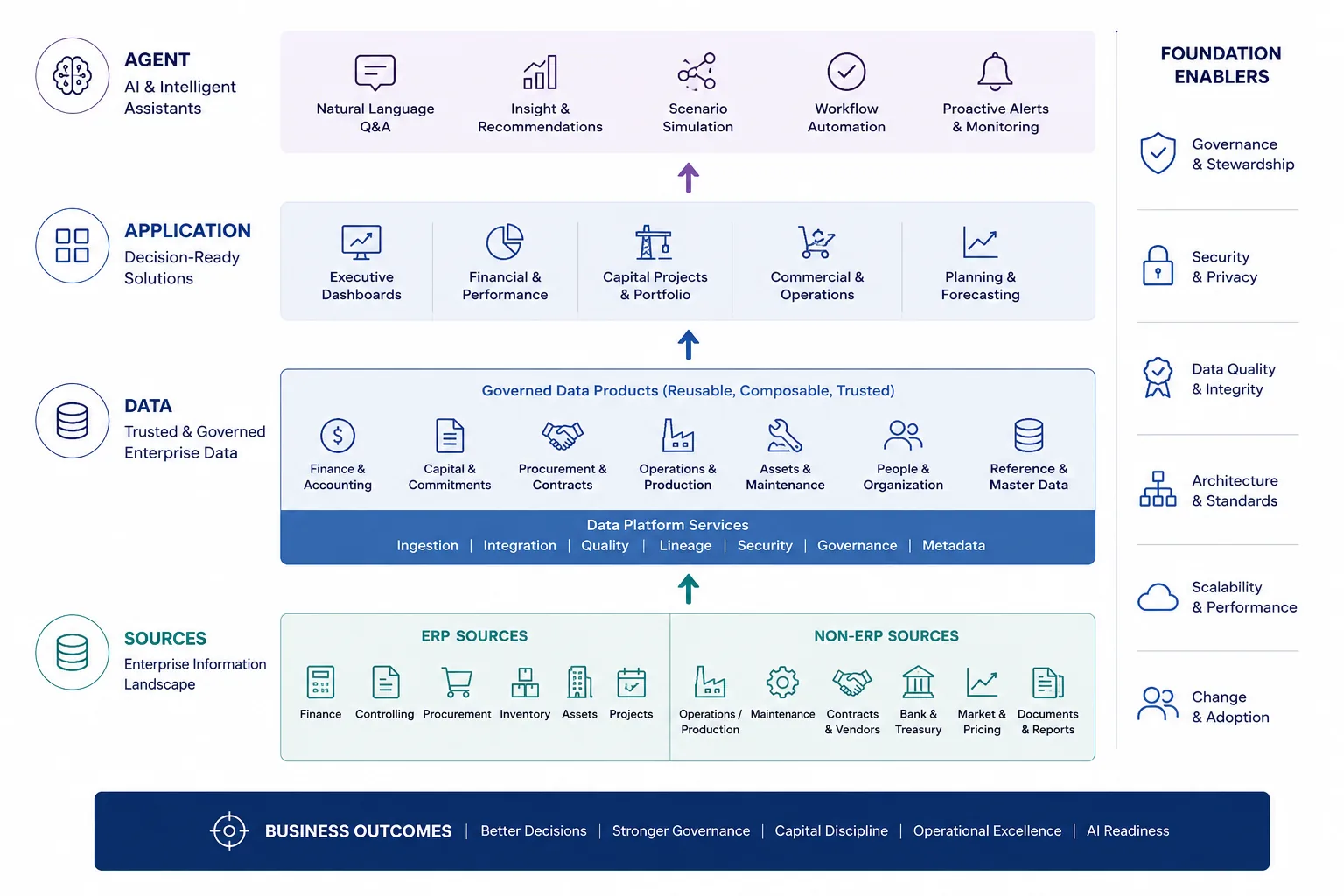
Your ERP Is the Starting Point, Not the Data Strategy
For many businesses, implementing an enterprise resource planning system is treated as the destination of digital transformation.
It is not.
An ERP platform is essential because it captures controlled transactions: purchases, invoices, payments, inventory movements, cost allocations, assets and financial records. But boards, CFOs and operational leaders rarely make important decisions using ERP transactions alone.
They need to understand:
- How much capital has been committed, not merely paid.
- Whether project expenditure is tracking against approved budget and forecast-to-complete.
- Whether cash resources remain sufficient for operating and development requirements.
- Whether production, inventory and commercial information can be reconciled to financial reporting.
- Whether management information is reliable enough for funding discussions, strategic partners or transaction scrutiny.
- Whether artificial intelligence can use enterprise data safely and meaningfully.
These questions require more than an ERP system. They require a governed information architecture that connects transactions with operational reality, commercial obligations, management assumptions and decision-making context.
That is where commercial data products become important.
The reporting problem is rarely a shortage of data
Capital-intensive businesses often hold large volumes of information across multiple environments:
- ERP and accounting systems;
- procurement and contract records;
- budgets and financial models;
- project-control spreadsheets;
- operational or production systems;
- maintenance records;
- bank and treasury information;
- engineering and consultant reports;
- regulatory and governance documents;
- market, pricing and external data.
The problem is usually not the absence of data. The problem is that information is fragmented, differently defined, manually manipulated and difficult to reconcile.
A finance team may extract actual expenditure from the ERP, obtain forecast updates from a project team, reconcile commitments through contract registers, add treasury assumptions from spreadsheets and build a management report through repeated manual work.
The report may eventually be produced. But the underlying process can be slow, dependent on individuals and difficult to scale.
This becomes increasingly problematic when a business is:
- moving from development into operations;
- managing significant capital expenditure;
- expanding across jurisdictions;
- seeking external funding or strategic partners;
- preparing for production;
- introducing artificial intelligence into business workflows.
In those circumstances, the organisation needs more than reports. It needs repeatable, governed information assets.
From data extracts to commercial data products
A data product is a reusable, controlled set of information designed to support a defined business decision.
It is not simply an exported spreadsheet or dashboard.
Consider a mining development company seeking reliable visibility over capital expenditure and commitments. A dashboard showing paid invoices will not answer the whole question. Management also needs to understand approved budgets, purchase commitments, contract obligations, accruals, forecast cost to complete, foreign exchange impacts and cash implications.
A governed Capital Expenditure and Commitments Data Product would establish:
- the approved budget baseline;
- actual expenditure definitions;
- committed-cost treatment;
- accrual and forecast rules;
- currency-conversion methodology;
- work breakdown or project hierarchy;
- reconciliation back to authoritative source records;
- responsible data owners;
- refresh and approval processes;
- appropriate access controls.
Once established, that same trusted data product can support:
- monthly management reporting;
- board reporting;
- treasury and cash-flow planning;
- procurement oversight;
- project-control decisions;
- funding discussions;
- strategic-partner due diligence;
- responsible AI-assisted analysis.
The value does not come from moving data into a new platform. The value comes from making business information reliable, reusable and decision-ready.
Business meaning matters more than data volume
A critical weakness in many digital-transformation initiatives is that technical connectivity is mistaken for business understanding.
Moving data from an ERP into a cloud platform does not automatically make the information useful.
A dashboard, analytical model or AI assistant must understand questions such as:
- Is expenditure operating cost, sustaining capital or project development capital?
- Is a forecast formally approved or simply a working estimate?
- Is cash unrestricted, committed or reserved for a defined purpose?
- Is inventory recorded under the correct accounting and operational treatment?
- Is a supplier commitment legally binding, conditionally approved or disputed?
- Do local operational classifications align with group-level reporting definitions?
These are not primarily technology questions. They are commercial, financial and governance questions.
For that reason, effective data architecture requires a business-semantic layer: clear definitions, mapping logic, hierarchies, reconciliations, ownership and controls that preserve meaning as information moves between operational systems, management reporting and analytical tools.
This is especially important in mining, energy and infrastructure, where operational information must ultimately connect with capital discipline, financial governance and strategic decision-making.
ERP data is necessary, but not sufficient
ERP remains the controlled transactional foundation. But management decisions rarely sit entirely inside the ERP environment.
A capital project may require integration of:
Decision requirementERP informationOther required information Capital controlPurchase orders, invoices, paymentsContracts, forecasts, engineering progress, approved variations Liquidity and fundingGeneral ledger and payablesBank balances, treasury placements, funding scenarios, cash forecasts Production readinessInventory, procurement, cost centresProcess data, operating assumptions, laboratory and maintenance information Commercial performanceBilling and inventoryPricing data, customer arrangements, transport and market assumptions Strategic readinessFinancial transactionsGovernance documents, risk registers, technical files and diligence materialsThe practical implication is clear:
ERP should be treated as the starting point of enterprise information architecture, not the boundary of it.
The objective is not to create uncontrolled copies of everything. The objective is to connect the information that management actually needs through appropriately governed data products.
Artificial intelligence makes data discipline more important, not less
AI adoption is accelerating interest in enterprise data. But businesses should be careful not to reverse the correct sequence.
The wrong question is:
How can we deploy AI across our business as quickly as possible?
The better question is:
What information can AI safely rely on, for which decisions, under what governance and with what human verification?
Artificial intelligence can assist with:
- querying management information;
- explaining budget variances;
- reviewing commercial obligations;
- identifying anomalies;
- supporting cash-flow analysis;
- searching controlled organisational knowledge;
- accelerating routine analytical work.
But its outputs will only be as reliable as the information and rules available to it.
Where source information is fragmented, poorly defined or unreconciled, AI can produce faster uncertainty rather than better decisions.
Responsible AI adoption therefore requires:
- clearly defined business use cases;
- trusted underlying data products;
- documented commercial and financial rules;
- controlled access and information security;
- appropriate human review for material decisions;
- traceability from output back to authoritative information.
For boards and CFOs, AI readiness should therefore begin with information governance and commercial data architecture, not technology procurement alone.
Technology should follow the business requirement
There is no universal platform answer.
Depending on the organisation's size, existing systems, security requirements, internal capability and investment appetite, an appropriate architecture may involve:
- an ERP-native data environment;
- Microsoft Azure or Microsoft Fabric;
- Databricks;
- Snowflake;
- Power BI-supported controlled reporting;
- an industry-specific system;
- a staged hybrid architecture.
The first decision should not be which platform to buy.
The first decision should be:
Which business decisions require better information, what trusted data products are needed to support those decisions, and what governance must be embedded before scaling the technology investment?
For many mid-market businesses, particularly in mining and project-based industries, a staged approach is more commercially sound than an enterprise-wide platform investment from day one.
A practical sequence
1. Identify high-value decisions
Focus on the issues management and the board genuinely need to control: cash, capital expenditure, commitments, forecasting, inventory, production cost, procurement, reporting or strategic readiness.
2. Map the information landscape
Understand where authoritative information exists, where spreadsheets or manual interventions remain necessary, and where data definitions are inconsistent.
3. Define priority data products
Establish the governed datasets, rules, reconciliations and ownership required to support the highest-value decisions.
4. Select proportionate architecture
Evaluate platform options only once business requirements, controls, scale and likely future use cases are understood.
5. Pilot before scaling
Implement one bounded, high-value data product and test whether it improves management outcomes before committing to broader architecture investment.
6. Enable analytics and AI responsibly
Once trusted data products exist, analytics and AI can be introduced with significantly greater confidence.
Where the greatest value often sits
For capital-intensive businesses, the highest-value initial data products are frequently not technically exotic. They are commercially fundamental:
- cash and liquidity visibility;
- capex, commitments and forecast-to-complete;
- management flash reporting;
- budget-to-actual and cost-control analysis;
- procurement and supplier exposure;
- inventory valuation and production-cost readiness;
- strategic-partner or transaction-readiness information.
These are matters that directly affect management decisions, board confidence, capital allocation and enterprise value.
They are also areas where a purely technical implementation approach may fall short. A successful solution must understand accounting treatment, contractual obligations, operational context, governance and commercial risk.
A finance and governance-led approach to data transformation
At Analytix Finsights, we view data transformation through a commercial decision-making lens.
The objective is not to introduce technology for its own sake. It is to help organisations build controlled information capability that supports:
- stronger financial governance;
- clearer capital discipline;
- more reliable management reporting;
- scalable operational decision-making;
- responsible AI adoption;
- improved readiness for growth, funding or strategic opportunities.
Our approach is built around five practical phases:
Control — Identify the decisions, definitions, reporting requirements and governance risks that matter most.
Connect — Map ERP and non-ERP information sources and determine how they should be accessed, integrated and controlled.
Productise — Design trusted, reusable commercial data products that support priority management decisions.
Enable — Apply reporting, analytics and responsible AI to governed information assets rather than fragmented raw data.
Scale — Develop a proportionate roadmap for further architecture, capability and investment once value has been demonstrated.
The strategic question for management teams
Digital transformation is no longer adequately addressed by asking whether an ERP has been implemented or whether an organisation has access to AI tools.
The more important questions are:
- Can management trust the information used to allocate capital?
- Can operational and financial information be connected consistently?
- Can the organisation explain where important numbers come from?
- Can new analytical or AI capability operate within appropriate controls?
- Can information stand up to board, investor, financier or strategic-partner scrutiny?
A modern ERP can provide the foundation.
But the organisations that extract lasting value from their data will be those that turn fragmented information into governed commercial products: reliable, contextual, reusable and aligned with real decisions.
That is the difference between holding data and using it as an enterprise asset.
Next steps
Analytix Finsights helps capital-intensive businesses assess their commercial data readiness, define priority data products and build practical, governed pathways toward improved reporting, capital control and responsible AI use.
Contact us to discuss where your ERP and operational information could be working harder for management decision-making.