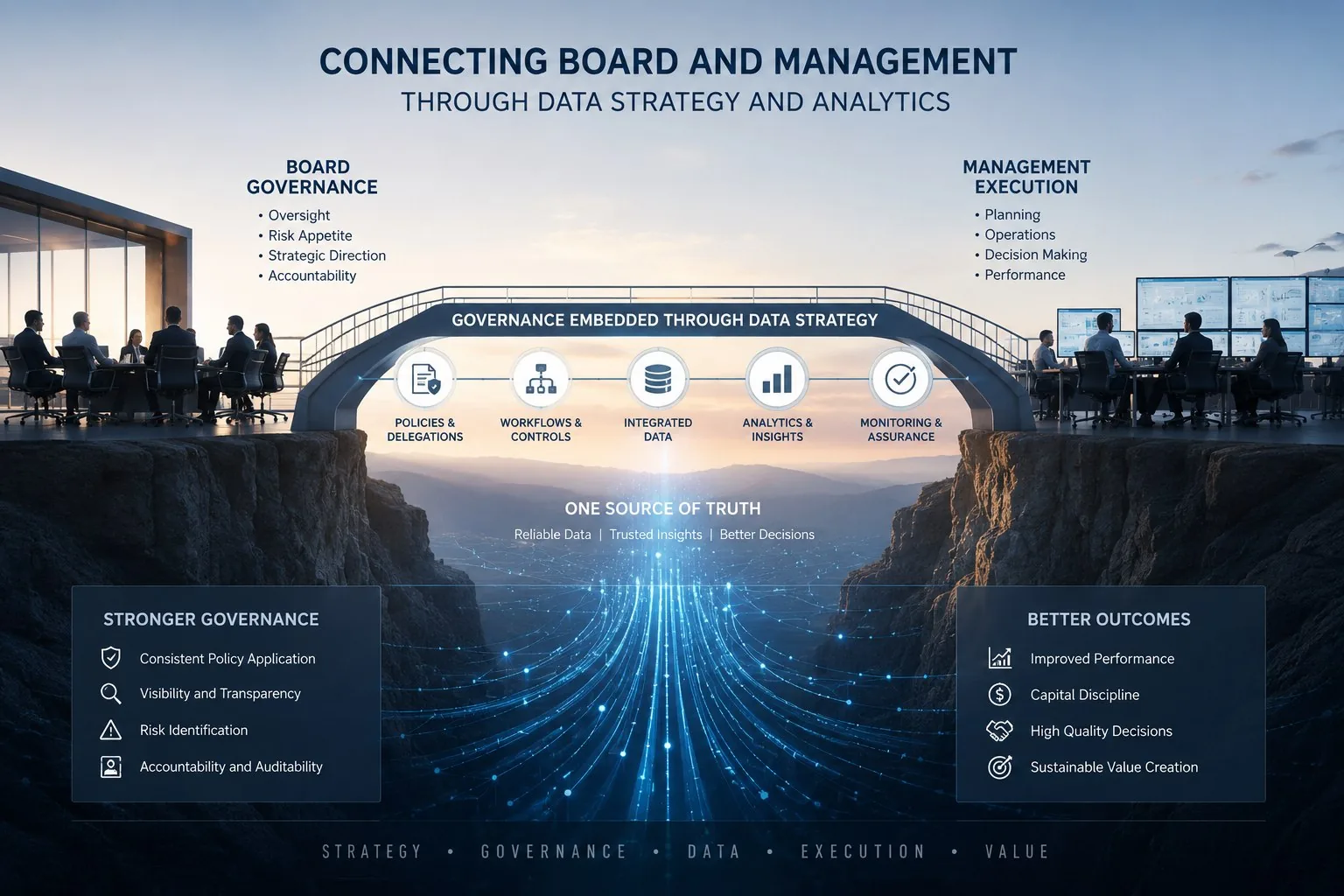
Why Governance Fails in Execution — And Why Data Strategy Is the Missing Link
Boards spend significant time establishing governance frameworks.
Delegations of Authority (DOA), procurement policies, approval matrices, budgeting procedures, risk registers and internal controls are all designed with a common objective:
To ensure that organisational decisions align with strategy, risk appetite and shareholder interests.
Yet despite these frameworks, many organisations continue to experience:
- Budget overruns
- Procurement irregularities
- Delayed reporting
- Inconsistent decision-making
- Control breakdowns
- Reduced accountability
The question is why.
The answer is often surprisingly simple.
Governance exists on paper.
Execution exists in data.
And the two are frequently disconnected.
The Governance Gap
In many organisations, governance is viewed as a compliance function.
Policies are documented.
Approval limits are defined.
Control frameworks are established.
Board committees review reports.
Management attends governance meetings.
From a governance perspective, everything appears to be in place.
However, when we observe how decisions are actually made throughout the organisation, a different picture often emerges.
- Purchase requests are approved via email.
- Budget reviews occur in spreadsheets.
- Project commitments are tracked outside core systems.
- Approvals are recorded inconsistently.
- Reporting relies on manual compilation and reconciliation.
The organisation possesses governance structures, but those structures are not embedded within day-to-day operational workflows.
This creates what we refer to as a governance-execution gap.
Governance Is Not a Policy Problem
Many organisations respond to governance challenges by creating additional policies.
More procedures.
More approval forms.
More oversight.
Unfortunately, this often increases administrative complexity without improving control.
The issue is rarely a lack of governance documentation.
The issue is that governance has not been translated into operational data architecture.
Policies tell people what should happen.
Data systems determine what actually happens.
A Practical Example
During a recent review of a mining operation undergoing rapid growth, we observed a common pattern.
The organisation had:
- Formal Delegations of Authority
- Procurement procedures
- Budget approval requirements
- Vendor onboarding controls
- Documented governance policies
From a board perspective, governance appeared mature.
However, execution relied heavily on:
- Email approvals
- Manual review processes
- Spreadsheet-based tracking
- Individual judgement
- Limited workflow enforcement
The challenge was not governance design.
The challenge was governance execution.
For example:
A procurement approval process may require three levels of approval according to policy.
If those approvals occur through email chains outside the core business system, the organisation loses:
- Visibility
- Auditability
- Accountability
- Reporting consistency
Governance becomes dependent upon people remembering to follow the process rather than systems enforcing the process.
This is where governance becomes vulnerable.
Data Strategy as a Governance Strategy
Many organisations view data strategy as a technology initiative.
It is often associated with:
- Business Intelligence
- Dashboards
- Artificial Intelligence
- Data Warehouses
- Analytics Platforms
While these capabilities are important, they are not the starting point.
The starting point is governance.
A mature data strategy should answer several critical questions:
- How are decisions made?
- Who approves them?
- What data supports those decisions?
- How are controls enforced?
- How are exceptions identified?
- How does the board gain confidence that governance is operating effectively?
When viewed through this lens, data strategy becomes far more than reporting.
It becomes the mechanism that connects governance intent with operational reality.
The Evolution of Governance Maturity
Organisations typically progress through four stages.
Stage 1: Policy-Based Governance
Controls exist primarily as documents.
Compliance depends on individual behaviour.
Stage 2: Workflow Governance
Policies are translated into system workflows and approval processes.
Compliance becomes more consistent.
Stage 3: Data-Driven Governance
Management receives real-time visibility into policy adherence, exceptions and emerging risks.
Stage 4: Governance Intelligence
Boards and executives gain predictive insights into operational, financial and strategic risks before issues materialise.
This is where governance moves from compliance to strategic advantage.
Why This Matters to Boards
Boards are ultimately accountable for governance.
However, boards do not manage daily operations.
Management does.
The challenge therefore is not whether governance frameworks exist.
The challenge is whether governance frameworks are embedded within the systems, data and workflows used by management every day.
When governance is embedded into operational data architecture:
- Decisions become more transparent.
- Controls become more reliable.
- Reporting becomes more trusted.
- Accountability becomes clearer.
- Risk becomes more visible.
Most importantly, boards gain confidence that organisational behaviour aligns with governance intent.
Final Thought
The future of governance is unlikely to be achieved through more policies.
It will be achieved through better integration between governance, systems, workflows and data.
The organisations that succeed will not necessarily have the largest governance manuals.
They will have governance embedded directly into the way decisions are made.
Because ultimately, governance is not what is written.
Governance is what the organisation actually does.
And what organisations do is reflected in their data.