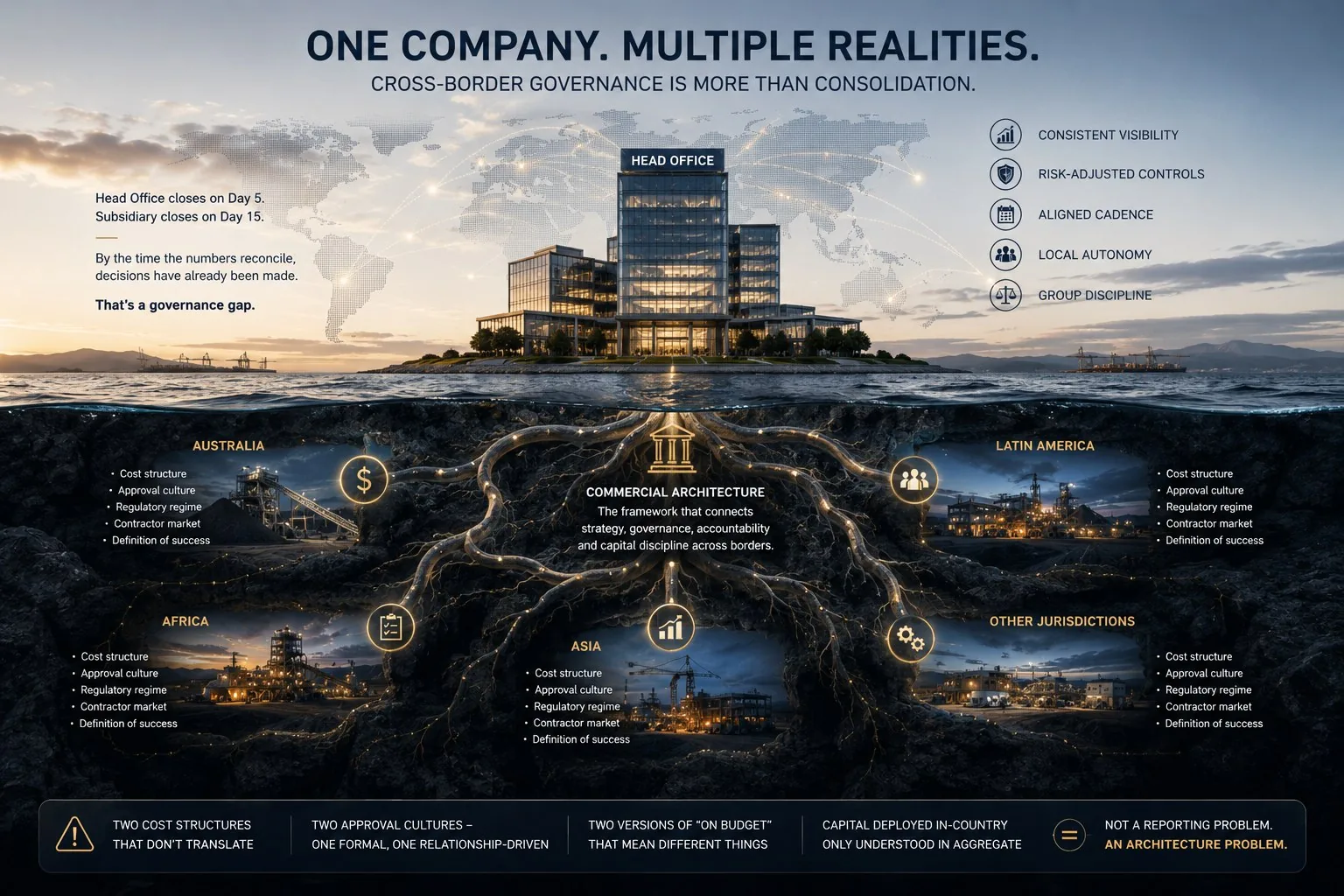
One Company. Multiple Realities.
Why Cross-Border Governance Is More Than Consolidation
The head office closes the books on Day 5.
The subsidiary closes on Day 15.
By the time the numbers reconcile, the board has already approved the next capital allocation decision.
Most organisations view this as a reporting delay.
It isn't.
It is a governance gap.
Because by the time management and the board are looking at the same information, critical decisions have already been made.
The issue is not timing.
The issue is alignment.
Consolidation Creates Visibility. It Does Not Create Governance.
When organisations expand across jurisdictions, a common assumption emerges.
Implement an ERP. Standardise reporting. Produce consolidated financial statements. Complete the audit.
Problem solved.
From a financial reporting perspective, that may be true.
From a governance perspective, it is often only the beginning.
Because consolidation tells leadership what happened.
It does not necessarily tell leadership whether the organisation is operating consistently.
And consistency becomes increasingly difficult as organisations expand across borders.
One Company. Multiple Operating Realities.
On an organisational chart, the business appears unified.
In reality, each jurisdiction often develops its own operating logic.
Different labour markets. Different supplier ecosystems. Different regulatory environments. Different infrastructure constraints. Different decision-making cultures.
What appears to be a single organisation is often a collection of operating realities connected through ownership and reporting structures.
This is not inherently a problem. In many cases, local adaptation is essential.
The challenge emerges when governance frameworks fail to evolve alongside this complexity.
The Illusion of Alignment
One of the most common observations in multi-jurisdiction organisations is the illusion of alignment.
The same terminology is used throughout the business. The same reports are produced. The same systems are implemented. The same governance documents exist.
Yet operational interpretation varies significantly.
"On budget" may mean one thing at head office and something entirely different at site level.
A procurement approval process may be viewed as a control in one jurisdiction and an administrative hurdle in another.
A capital expenditure threshold that appears appropriate in Australia may create unintended consequences in a developing operating environment.
Everyone believes they are following the same governance model.
In practice, they are often following different versions of it.
The organisation appears aligned until a major decision exposes the differences.
Cross-Border Governance Is Not a Reporting Problem
When governance tensions emerge, organisations frequently focus on reporting.
Faster closes. More dashboards. Additional management reports.
These improvements are valuable.
But they rarely address the root cause.
The issue is not that information arrives too slowly.
The issue is that the governance architecture was never designed for a multi-jurisdiction environment.
Reporting simply reveals the gap. The gap already existed.
The Hidden Complexity of Capital Discipline
Capital discipline becomes significantly more difficult when organisations operate across borders.
Not because leaders lack discipline.
Because the operating context changes.
The same investment can carry very different risks depending on:
- Jurisdiction
- Supply chain maturity
- Political environment
- Infrastructure availability
- Local management capability
- Regulatory complexity
Yet many organisations apply identical governance frameworks across fundamentally different operating environments.
The result is often predictable.
Either controls become too rigid for local operations.
Or local flexibility gradually weakens group discipline.
Neither outcome supports sustainable growth.
What Effective Cross-Border Governance Looks Like
The organisations that navigate multi-jurisdiction growth successfully tend to focus less on consolidation and more on architecture.
They recognise that governance must be intentionally designed to operate across different environments.
This often includes:
A Common Commercial Language — Cost categories, project structures and performance measures that translate consistently across entities.
Risk-Adjusted Governance — Approval thresholds and controls that reflect jurisdiction-specific risk rather than assuming identical operating conditions.
Decision-Making Visibility — Governance structures that allow head office to understand local decisions before they become group-level issues.
Cadence Alignment — Management information cycles designed to support decisions, not simply reporting deadlines.
Local Autonomy Within Group Discipline — Enough flexibility to enable effective operations without losing enterprise-wide accountability.
The objective is not centralisation.
The objective is coherence.
Governance Exists Between The Numbers
One of the most dangerous assumptions in cross-border organisations is that governance can be measured solely through financial reporting.
Financial reports tell part of the story.
Governance exists between the numbers.
It exists in:
- How decisions are made
- How risks are escalated
- How capital is allocated
- How priorities are interpreted
- How accountability is exercised
These factors rarely appear directly in consolidated financial statements.
Yet they often determine whether the organisation succeeds or struggles as it grows.
Final Thought
The challenge of cross-border governance is not connecting systems.
It is connecting realities.
The visible organisation may appear to be one company.
The invisible organisation often operates as multiple businesses with different constraints, cultures and decision-making patterns.
Consolidation can bring the numbers together.
Governance must bring the organisation together.
Because sustainable growth across jurisdictions depends on more than visibility.
It depends on creating a commercial architecture capable of maintaining discipline across multiple operating realities.
And that is a governance challenge long before it becomes a reporting challenge.